A primary sources analysis. . .
Source Description
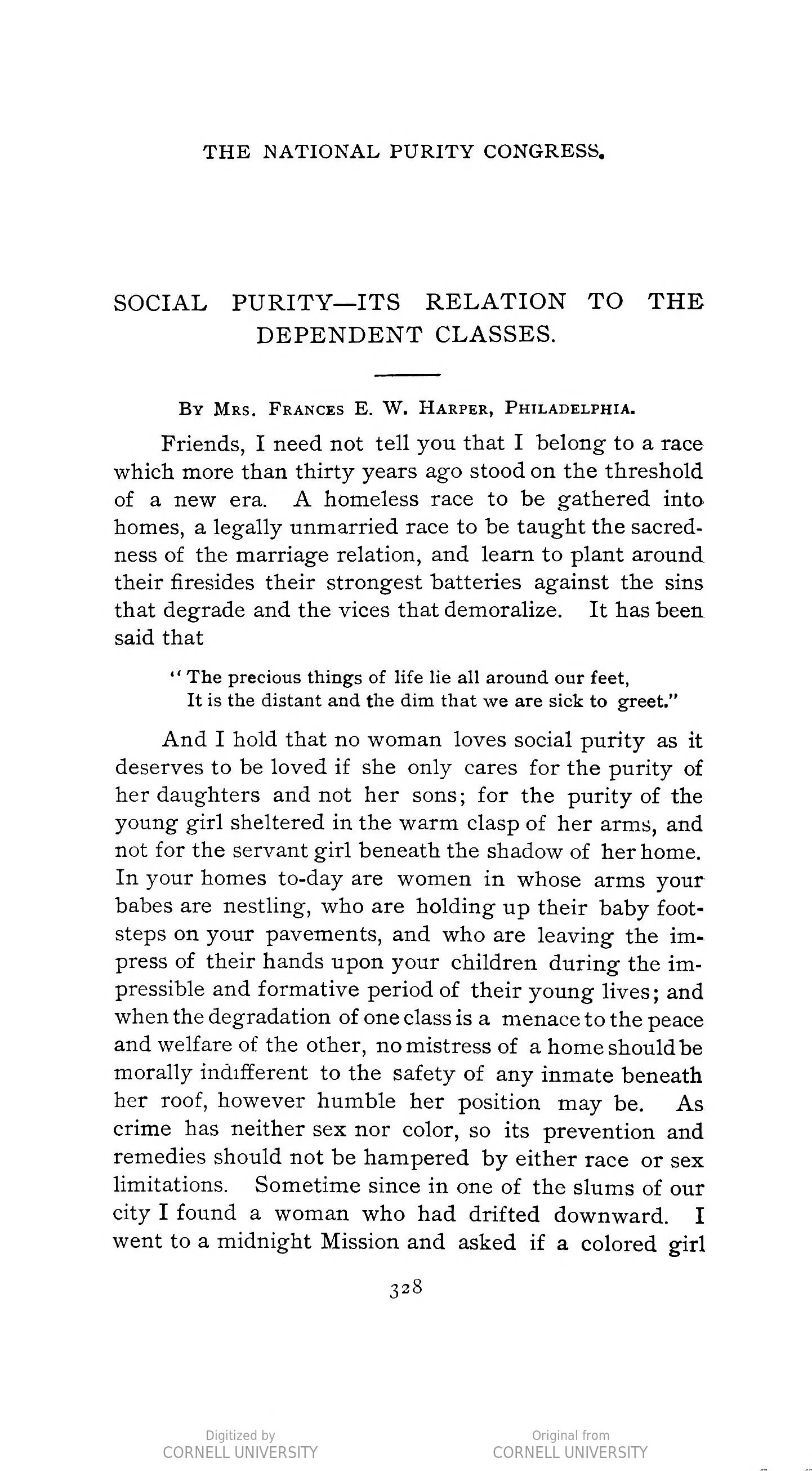
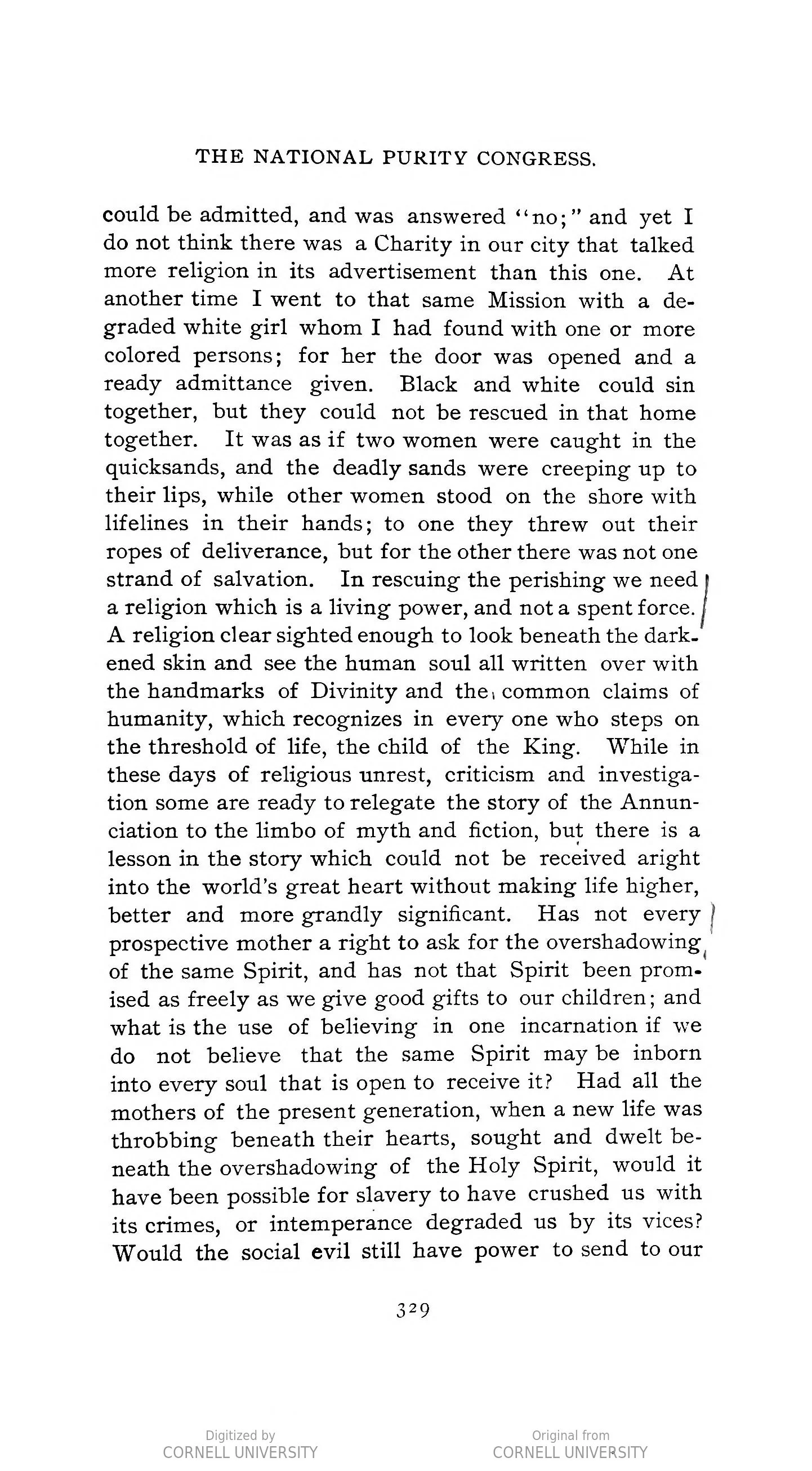
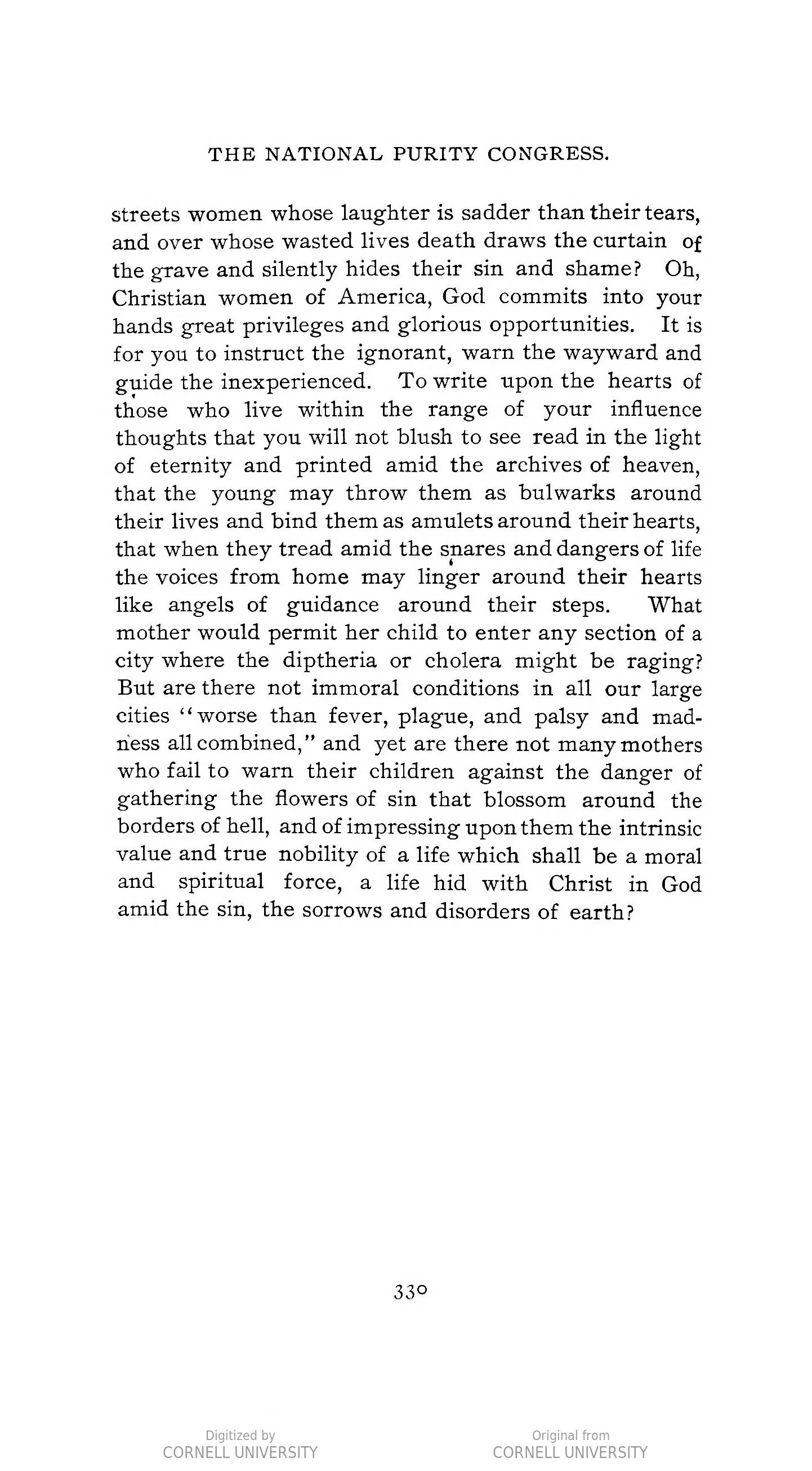
“Social Purity—Its Relation to the Dependent Classes” is a printed, textual account of an address given to the attendants of the first meeting of the National Purity Conference by Black abolitionist, Frances E.W. Harper at the Park Avenue Friends’ Meeting House in Baltimore, Maryland in October of 1895. Printed months after the event itself, in 1896, the words appear in a clear and legible, serif font seen commonly in printed documents from the late nineteenth century. Frances E.W. Harper’s address runs the expanse of just over two pages in a roughly 455-page collection of papers, addresses, letters, remarks and portraits from the National Purity Conference of 1895. Emblazoned on the top of each printed page in all-capitalized lettering reads “THE NATIONAL PURITY CONGRESS.” A roughly half inch, centered line segment separates the title from the speaker’s name which is printed in a smaller font, all-capitalized lettering: “BY MRS. FRANCES E.W. HARPER, PHILADELPHIA.”
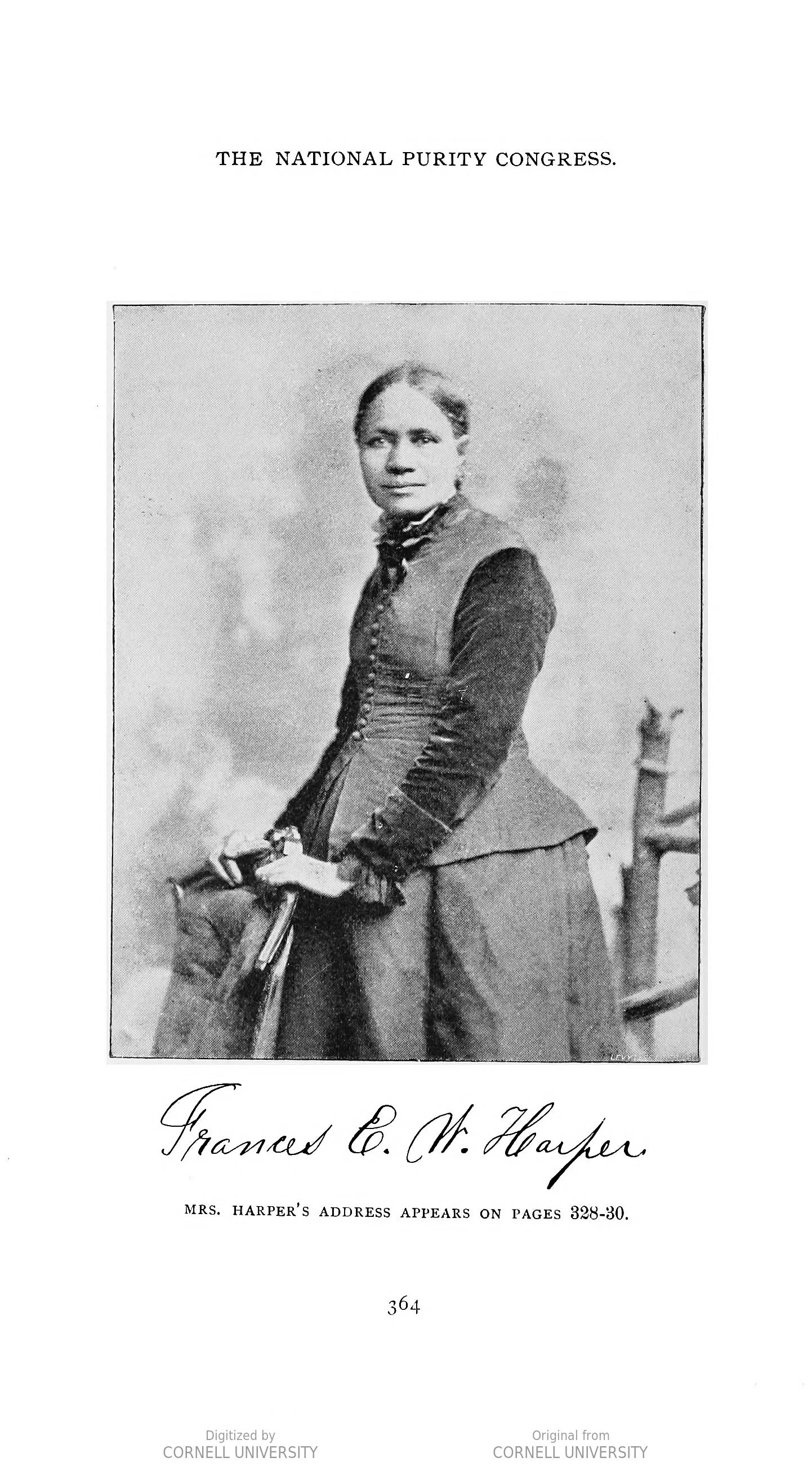
While most of the written accounts printed in this volume feature a printed portrait of the white-presenting person who wrote or delivered the various letters and addresses alongside the text—either on the page immediately before or immediately following the text—Frances E.W. Harper’s portrait can be found buried thirty-four pages away from the written account of the speech she delivered at the National Purity Congress meeting, as if it were an afterthought to include a portrait of the only Black woman featured in the volume. In her portrait, Frances E.W. Harper’s kind eyes and soft smile peer directly into the camera. She is standing with her hands rested on the back of an upholstered chair, framed with lacquered wood. Her hair is parted in the middle and though the back of her head is not depicted, it appears as though it is tightly pinned up in a bun at the nape of her neck. Harper is wearing a fashionable, but modest tailormade two-piece walking suit that appears to be comprised of substantial taffeta. The basque jacket has a high collar and is punctuated down its center by several fabric-covered buttons. Beneath the sleeveless vest-style jacket, she dawns a long-sleeved velvet blouse that has a subtle lace ruffle at the sleeve opening. The blouse also appears to feature an understated neck ruff. In neat cursive beneath her portrait which is framed with a thin black border and has the photographer’s somewhat-obscured, printed signature in the lower righthand corner, her signature is featured with all-capitalized words in a small font that read “MRS. HARPER’S ADDRESS APPEARS ON PAGES 328-30” below it.
Purpose
In the late nineteenth century, Black and white American reformers—both men and women—focused their efforts on social welfare to address a range of social “problems” through voluntary organizations and clubs like the National Purity Congress. The National Purity Congress, under the auspices of the American Purity Alliance, met to address the need for state regulation of sex work, the age of consent, to promote the “rescue” of “fallen men as well as fallen women,” and to discuss preventative education that would encourage “purity” to make the work of rescuing the aforementioned groups no longer a necessity. The broad purpose of printing the pamphlet that includes Harper’s address was to disperse information about these specific topics to people who were not in attendance at the Congress. The purpose of Harper’s address itself was to serve her greater reform goals which focused on racial and gender uplift.
Frances E.W. Harper was a free born Black abolitionist who is considered the preeminent African American woman writer of the nineteenth century. Her writings, published broadly, focused on themes of racial uplift for Black Americans after abolition and often centered protagonists who acted as mediators between white and Black Americans. This purpose is reflected in her address to the National Purity Congress. The Congress was concerned with protecting women from sexual deviance and violence. Harper took that message a step further in her address when she claimed that “crime has neither sex nor color.” She gently admonished white upper- and middle- class women for ignoring the abuse of Black domestic workers in their households. Her purpose in focusing on this specific moral dissonance was to expose the hypocrisy of the white upper- and middle-class who employed Black women to keep their homes and raise their children but turned a blind eye when white men “demoralized” them. Harper insists that white upper- and middle- class women’s role as protectors of their homes should extend to all who are a part of the domestic sphere, including Black women.
Methods
Frances E. W. Harper delivers her message about protecting all women in the domestic sphere, regardless of their race, by appealing to white women’s emotions, to their roles as mothers, and to their Christian faith. During the late nineteenth and early twentieth centuries, motherhood became a central organizing principle for reform movements. Upper- and middle- class white women considered themselves the mothers of the nation—whether they were biological mothers or not—who could better civilization from the confines of their households.3 When Harper addresses “mothers” in her speech and references the Biblical story of the Annunciation (which is the story of Mary consenting to become pregnant with Jesus Christ), she is appealing to this shared principle. By focusing on their shared Christian faith and roles as mothers, Harper asks attendants—specifically, white women attendants—of the National Purity Congress to “look beneath the darkened skin and see the human soul.” By using the language of the Christian faith, Harper strongly implies that when white women choose to look beyond skin tone when considering who deserves protection in their homes, they become like “angels of guidance” who are fulfilling the “glorious opportunities” that their shared god has bestowed upon them. Harper is likening the role of white women in the household to the role of supernatural deities when she uses this language.
Harper’s plea to white women to use their “hearts” and “souls” to “instruct the ignorant” and “warn the wayward” elucidates that she knew she needed to appeal to the women’s emotions for her message to be truly absorbed. Implementing her keen storytelling skills, Harper evokes an image of two women, one white and one Black, sinking in the same deadly quicksand while other women stood on the shore, watching. The women on the shore in this story had the capacity to rescue both sinking women from the quicksand but only rescued the white woman. In this metaphor, the quicksand is representative of the “social evil” of women who have resorted to sex work to survive in “the slums.” This story evokes a sense of urgency and communicates to National Purity Congress attendees that Harper knows white women have the capacity to “rescue the perishing” (that is, Black women) from the sexual exploitation of white men if they so choose. Framing the need for “rescue” as a matter of life and death from a force beyond human control and insisting that white women practice their faith as a “living power” rather than a “spent force” to help all women who “drifted downward” would likely have had a profound, emotional impact on her listeners. Harper is, in a sense, admonishing white women for ignoring the plight of Black women in their homes, but is wrapping the admonishment in flowery, flattering, fervent language that would have appealed to upper- and middle- class white women’s sense of self-ascribed saintliness.
Source as Representation
Frances E. W. Harper’s address delivered at the National Purity Congress in Baltimore reveals broader truths about liver in the U.S.—particularly in the urban Northeast—during the late nineteenth century. During this time, urban centers were experiencing rapid industrialization, urban growth, and widening class divisions. Cities like Baltimore were marked with poverty becoming more visible and people increasingly participating in wage labor like domestic service. Reform organizations like the American Purity Alliance emerged in response to anxieties about immigration, public morality, sex work, and the perceive breakdown of traditional, patriarchal,Abigail Swanson HIST666: Primary Source Analysis heteronormative, family structures. The focus on regulating sexuality, regulating the age of consent and rescuing “fallen” women reflects a society that was deeply concerned with moral order and social control. At the same time, Harper’s criticism of white households that championed morality while simultaneously ignoring the abuse of Black domestic workers reveals how racial inequality shaped daily life in nineteenth century urban centers. Black women were confined to low-paying domestic service roles in white homes and had little protection from exploitation. This source also reflects the racial climate of the 1890s. Although slavery ended three decades earlier, Black Americans still faced disenfranchisement, racial violence, and economic marginalization. As a Black abolitionist and reformer, Frances E.W. Harper spoke within a predominantly white reform movement that centered white women’s purity while ignoring the specific vulnerabilities of Black women who worked in their households. Her insistence that “crime has neither sex nor color” challenged racist stereotypes and the moral hypocrisy of many white women in the U.S. The marginal placement of her portrait in the published proceedings from the National Purity Congress further illustrates the racial hierarchies embedded within progressive reform spaces. The source highlights how religion, motherhood, race, gender, and class all intersected in late nineteenth-century America, revealing a nation struggling to define issues related to morality and citizenship.
Usage
Frances E.W. Harper’s address to the attendants of the National Purity Congress could be used to better understand the rhetoric of social reform movements in the late nineteenth century. If a researcher had an inquiry about the prevalent themes and language used in nineteenth century reform movement materials, Harper’s address could be used as an excellent example. Not only does Harper cover quite the gamut of issues central to nineteenth century reformers’ efforts—race, womanhood, motherhood, and sex—it is also presented using language that was pervasive in contemporary reformers’ writings, letters, and addresses. She evokes powerful emotional imagery in her storytelling and implements religious themes to bolster the profundity of her message. Her address encapsulates the cultural phenomenon of sentimentality that seeped into materials produced in almost all arenas during the nineteenth century.
It could also be used to better understand how nineteenth century Black American reformers navigated addressing predominantly white audiences. The 455-page collection of printed materials produced by the National Purity Congress that includes Harper’s address primarily features voices, words, and images of white-presenting people. Most of those who attended the National Purity Congress were also white. Despite this, Harper deftly addresses her audience and even overtly admonishes them for their hypocrisy while simultaneously complimenting them and asking them for their help in “rescuing” Black women from “the social evil.” Her address exemplifies the ways in which Black reformers and abolitionists navigated predominately white spaces to further their causes during the nineteenth century. She found common ground with her white audience in motherhood, family, and religion but did not shy away from using her address to challenge what she saw as a pervasive issue impacting Black Americans.